Home About Us History of District Judiciary
History of Noakhali District
Noakhali is an ancient and traditional district of the Chittagong Division, located in the southeastern region of Bangladesh. The district includes many islands and chars such as Hatiya, Nijhum Dwip, and Subarnachar. Administratively, it consists of nine upazilas.
The ancient name of the modern Noakhali territory was Bhuluya. Bhuluya was once considered the nerve center of the history of the Bay of Bengal coastal region. Long before the fame of the historic Subarna Gram (later known as Sonargaon), Bhuluya was already a flourishing seaport. Flowing beside it was the legendary Kshir Sagar (Sea of Milk), described in ancient texts and folklore. This ancient Kshir Sagar is today’s Bay of Bengal.
As early as pre-Christian times, the port of Bhuluya was a center of international maritime trade. In the mid-13th century, Muhammad bin Tughluq became the Sultan of Delhi. During the early years of his rule, the entire Samatat region—including Bhuluya—remained independent. In the third decade of the 14th century, Tughluq’s general conquered Tripura, Bhuluya, and Chittagong, bringing these regions under the Delhi Sultanate. Afterward, Bahram Khan established his ruling center in Bhuluya. Later, Sultan Tughluq appointed Fakhruddin as the governor of Bhuluya, which served as his eastern provincial capital.
Bhuluya continued to exist throughout various historical periods, including the Buddhist, Pala, Sena, independent Sultanate of Bengal, Pathan-Turkish, Mughal, and East India Company eras. Geographically, Bhuluya was located near present-day Bhabaniganj, north of Ramgati in today’s Lakshmipur district.
According to Major Rennell’s 1773 map of Bengal, rivers from the northern hills flowed across vast southern plains into the sea. To the south were Bhuluya, Bamni, Shahar Kasba, Farajganj, Bhabaniganj, and Companyganj—flourishing maritime ports. Historical accounts indicate that in the past two hundred years, the sea engulfed certain tracts of land seven to ten times. It is believed that ancient Bhuluya was also eventually lost to the sea.
During the Mughal period, the famous port along the Meghna River was known as Shahar Kasba, also called Bhuluya Port. To its north were the grand Bhuluya royal palace, Bhuluya Dighi (large reservoir), royal fort, and the capital of Bhuluya.
In 1821, the region was declared a district, still under the name Bhuluya. Later, in 1868, the district’s administrative name was changed to Noakhali, and in 1876, Noakhali was officially recognized as a full district. That same year, the first Noakhali Municipality was established on land donated by a local landowner named Sudharam. Hence, the town became known as Sudharam town.
Noakhali played a significant role in many political and social movements. Its people were actively involved in the Jihad Movement of 1830 and the Khilafat Movement of 1920. In 1946, Mahatma Gandhi came to Begumganj of Noakhali as part of his peace mission, where he established the Gandhi Ashram at a place called Joyag. The Ashram gained fame as a historic and philanthropic institution.
History and Heritage of Noakhali District & Sessions Judge Court
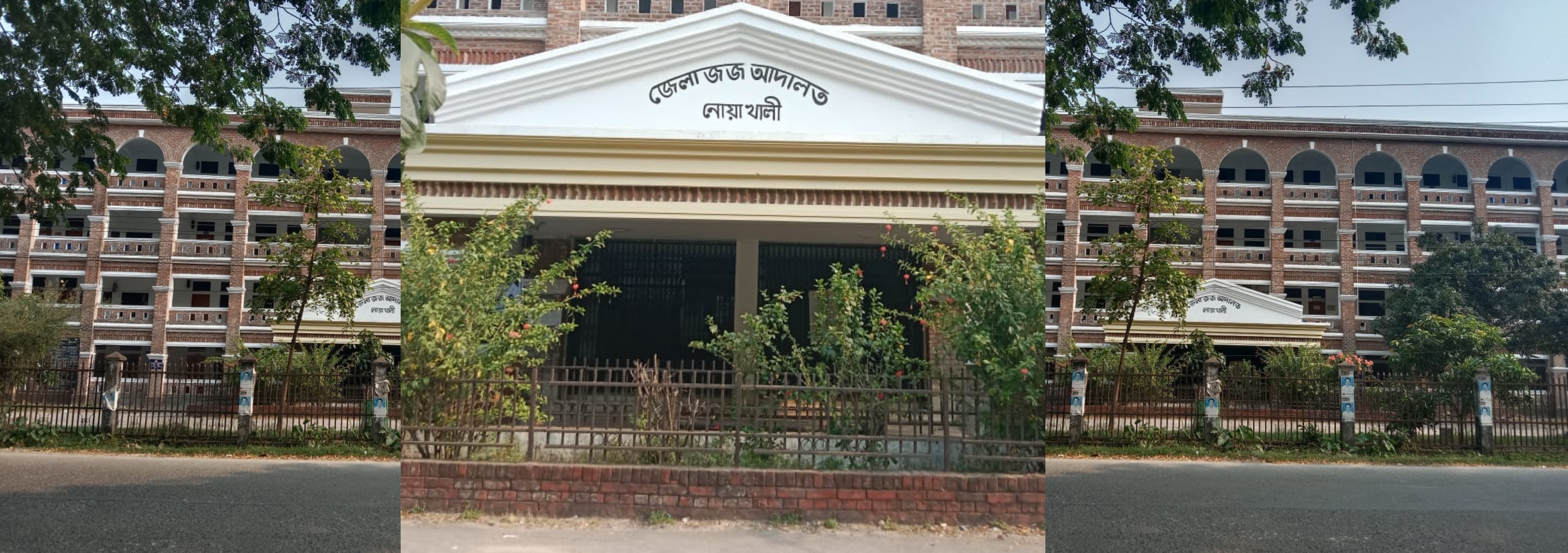
After Noakhali achieved full status as a district in 1876, the Civil and Sessions Court formally began functioning on 1st May 1877, with the establishment of the office of the District Judge. In Sudharam town, the Judge Court building was a two-storied structure built of red bricks. This centuries-old Noakhali Judge Court was modeled after the Calcutta High Court, adorned with decorative tiles. It was once the main architectural attraction of the town.
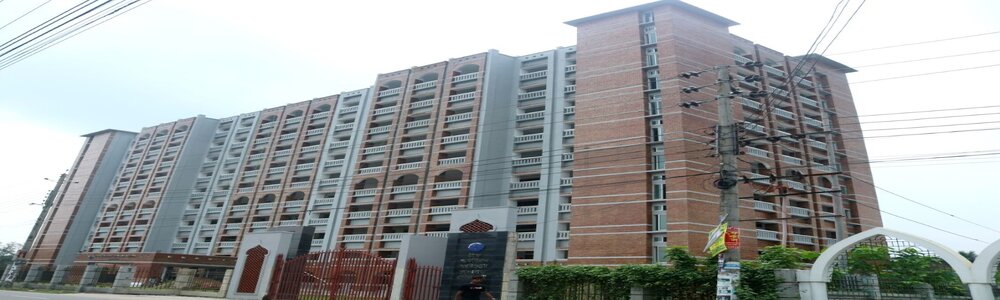
However, when the building was engulfed by the river, a new District & Sessions Judge Court building was constructed in Maijdee town, where judicial activities commenced on 1st January 1949. Later, in 1965, a new court building was erected. On 6th April 2006, a newly constructed modern court building was inaugurated, and since then, judicial functions have continued there.
Following the separation of the judiciary in 2007, the Chief Judicial Magistrate Court was established in Noakhali. Subsequently, on 10th October 2019, a modern building for the Chief Judicial Magistrate Court was inaugurated, and judicial officers began conducting court proceedings there.
History of Hatiya Sub-Courts
Noakhali’s remote island upazila Hatiya has two sub-courts:
A Senior Assistant Judge Court
A Senior Judicial Magistrate Court
The first judicial activities of the Hatiya Sub-Court began on 19th January 1912.
The first president of the Hatiya Lawyers’ Association was Advocate Naba Chandra Das, and the first general secretary was Advocate Mostafizur Rahman. The island’s first Honorary Magistrate was Abdul Motaleb, B.A., B.T., and the first appointed Magistrate of the Hatiya Court was Mohammad Shamsuddin.
History of the Noakhali District Bar Association
The Noakhali District Bar Association was established in 1886. Initially, its activities were conducted in a small tin-shed house located at the southeast side of the present Bar Association building.
In 1972, Advocate Abdul Malek Ukil laid the foundation stone of the current Bar Building. The Bar Library was shifted to this new building in 1977.
Apart from their legal careers, many members of the Noakhali Bar also served the nation as political leaders and ministers. Among them were Abdul Gofran, Khan Bahadur Rezzakul Haider Chowdhury, Abdul Malek Ukil, and Md. Ismail, who served as ministers in the Government of Bangladesh. Abdul Malek Ukil was also a member of the Bar Council.
Several others—including Sayedul Haque, Fazlur Rahman, Seraj Uddin Ahmad, Munsurul Haque, Md. Ruhul Amin, Ali Azzam, Sakayet Ullah, Bismillah Mia, Professor Mohammad Hanif, and Salauddin Kamran—were elected Members of Parliament. In addition, Syed Abdul Majid Chowdhury and Syed Ahmad served as Chairman and Vice-Chairman of the District Board.
During the Bangladesh Liberation War of 1971, many members of the Noakhali Bar Association participated as freedom fighters, including Advocate Abdul Malek Ukil, Advocate Sakhawat Ullah, Advocate Bismillah Mia, Advocate Abdur Rob, Advocate Zainal Abedin, Advocate Lutfur Rahman, Advocate Abul Khair, and Advocate Fazlul Kabir.
Other freedom fighters such as Advocate Sarwar-e-Din, Advocate Mostafizur Rahman Latu, Advocate Momin Ullah, Advocate Md. Shahjahan, and Advocate Niamat Ullah joined the Bar Association after independence.
Tragically, during the war, the Pakistani occupation forces brutally killed two distinguished members of the Noakhali Bar: Rai Bahadur Advocate Nagendra Sur and Advocate Narendra Kumar.